

Online vs Offline Coaching for Sainik School 2026: The Decision Nobody Wants to Make
Uncle Sharma (different from me!) called me frustrated.
"Sharma ji, I've asked 10 parents. Everyone says something different. One swears by online (₹800/month, daughter at home). Another swears by offline (₹6,000/month, son disciplined now). Another does BOTH (spending ₹8,000/month combined). Who's right? Or are they all making different choices for DIFFERENT reasons?"
"Uncle, exactly. This isn't about which is objectively better. This is about which fits YOUR family's situation. Let me explain the 6 real factors that actually matter."
The Question Everyone Gets Wrong
Common question: "Which coaching is BETTER - online or offline?"
Better answer: "Better for WHOM? Under WHAT circumstances?"
Why this matters:
Online coaching that's perfect for one family is disaster for another. Offline coaching that transforms one student bores another.
The question isn't "which is better?" The question is "which works for US?"
Understanding how families actually decide reveals patterns others miss.
Factor 1: Your Child's Self-Discipline Level (Most Important)
This single factor predicts success more than anything else.
High Self-Discipline Child
Profile:
- Studies without being told
- Completes homework without reminders
- Can focus for 2-3 hours independently
- Plans own schedule
- Doesn't need external structure
Online coaching: 95% success rate Why: Child studies anytime, doesn't procrastinate, takes notes, reviews videos
Offline coaching: 85% success rate Why: Child might waste commute time, finds rigid schedule slightly limiting
Verdict: Online is BETTER for this child (saves time/money too)
Real example: Priya studies at 6 AM before school. Online coaching videos fit perfectly. She watches 1 video (30min), practices problems (30min), done. Offline would require 1-hour commute for same learning.
Medium Self-Discipline Child
Profile:
- Studies IF reminded
- Sometimes skips homework
- Can focus 1-1.5 hours before distracted
- Needs external structure
- Procrastinates frequently
Online coaching: 45% success rate Why: Studies incomplete because no external pressure. Watches video, doesn't practice. "I'll practice later" → never happens
Offline coaching: 80% success rate Why: Fixed class time = forced to show up. Peer presence = motivating. Teacher notices when daydreaming
Verdict: Offline is MUCH BETTER for this child
Real example: Arjun joined online coaching. Watched lectures. Never did practice problems. Got worse. Switched to offline (₹6,000/month). Fixed 5 PM class = forced attendance. Improved significantly.
Low Self-Discipline Child
Profile:
- Doesn't study without pressure
- Skips homework regularly
- Distracts easily (phone, gaming)
- Needs constant monitoring
- Parents consider boarding school for this reason
Online coaching: 10% success rate (nearly impossible) Why: No structure, maximum distraction potential. Child watches YouTube instead of coaching videos.
Offline coaching: 60% success rate (still challenging) Why: At least fixed class time enforced. But still might bunk classes.
Verdict: Even offline hard. Might need boarding school + offline combo
Real example: Kumar's parents tried online. Kumar watched 10 minutes of videos, played PUBG. They gave up. Tried offline. Kumar still bunked. Finally admitted Kumar to boarding school + offline coaching. Then improved.
Self-Discipline Assessment (Which are YOU?):
Answer YES/NO to each:
- Studies without reminders?
- Completes homework daily?
- Focuses 2+ hours independently?
- Plans own schedule?
- Rarely procrastinates?
Score: 4-5 YES = High discipline (Online perfect) Score: 2-3 YES = Medium discipline (Offline better) Score: 0-1 YES = Low discipline (Offline + parents supervise, or reconsider)
Factor 2: Home Environment Quality
What "quality" means:
NOT: "Do you have nice furniture?" YES: "Is your home study-friendly?"
Good Study Environment at Home
Characteristics:
- Quiet study room (no TV noise, sibling games)
- Good lighting (not dark corner)
- Minimal daily interruptions (parents respect study time)
- WiFi stable (for online if needed)
- Phone not constantly accessible
Online coaching: 90% effective Why: Home environment supports learning, not distraction
Offline coaching: 85% effective Why: Good, but child loses study time in commute + already has good environment
Verdict: Online saves 2+ hours daily commute. Why waste it?
Real example: Isha's home: Separate study room, quiet parents, WiFi fast. Online coaching works perfectly. 2 hours saved daily vs neighbors who commute to offline.
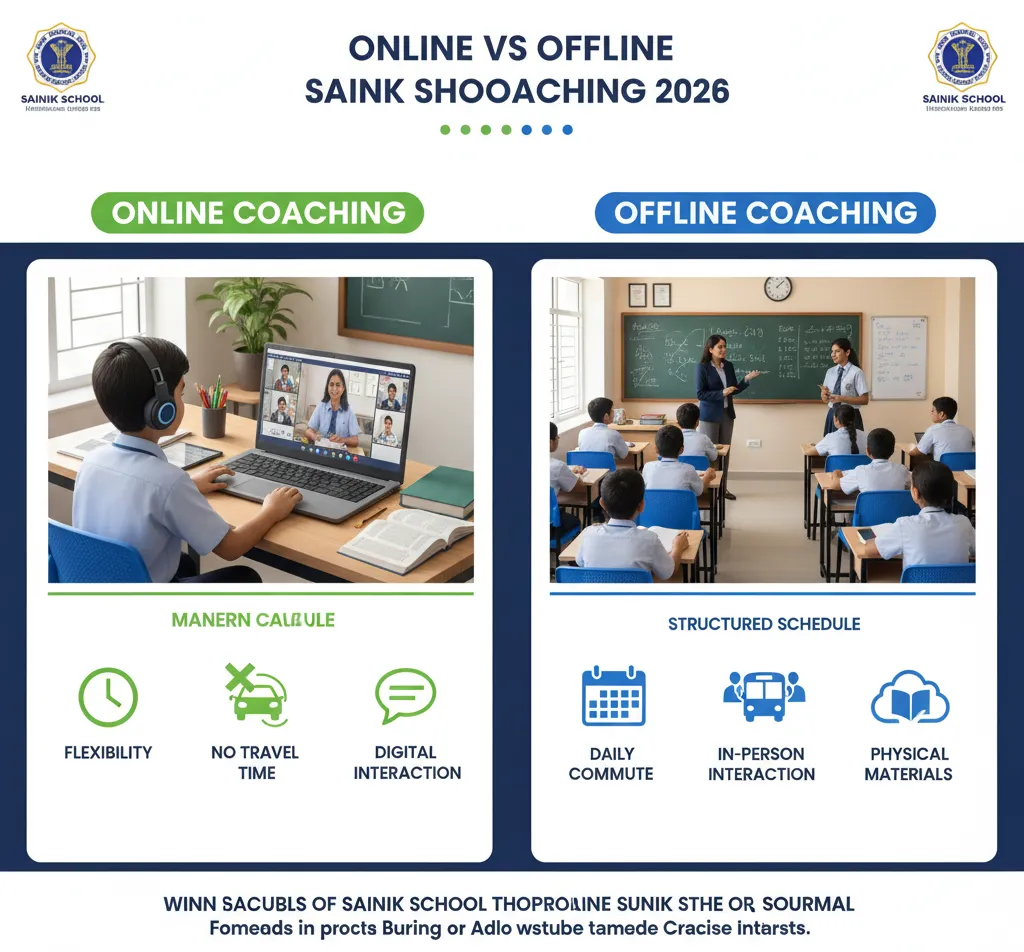
Chaotic Study Environment
Characteristics:
- Living room study (TV always on)
- Loud family (siblings, relatives)
- Constant interruptions (phone calls, errands)
- WiFi unreliable
- Phone easily accessible (temptation)
Online coaching: 20% effective Why: Child opens coaching video, gets distracted by TV noise. Decides to study later. Never happens.
Offline coaching: 75% effective Why: Forced out of chaotic home. Focus possible away from home
Verdict: Offline is ESSENTIAL for this family
Real example: Rajesh's home: 1 room, 5 people, constant noise. Online coaching useless. Offline class = escape from chaos. Improved significantly.
Home Environment Assessment:
Count TRUE statements:
- Separate study room exists?
- Family respects study hours?
- Under 30dB noise level during study?
- WiFi reliable (100+ Mbps)?
- Child can keep phone away?
- TV not in study area?
Score: 5-6 TRUE = Good environment (online viable) Score: 3-4 TRUE = Okay environment (offline recommended) Score: 0-2 TRUE = Poor environment (offline necessary)
Factor 3: Your Family's Time Constraint
This is purely logistical.
Commute Time Available
Scenario A: Offline center 20-30 min away
Total time investment:
- Commute: 40-60 min daily (round trip)
- Class: 2-3 hours
- Daily total: 3-4 hours
Is 3-4 hours daily reasonable?
- If YES (empty schedule, no other activities) → Offline fine
- If NO (school, sports, other activities) → Online better
Real math:
- School ends: 2 PM
- Coaching commute: 2:30 PM start
- Offline class: 5:30 PM end
- Home: 6:15 PM
- Dinner, bath: 6:15-7 PM
- Self-study: 7-8 PM only (1 hour)
VS Online:
- School ends: 2 PM
- Immediate online class: 2:30-3:30 PM (30min)
- Practice: 3:30-5:30 PM (2 hours)
- Free after 5:30 PM
- Way more flexible
Scenario B: Offline center 45-60 min away
Daily time:
- Commute: 90-120 min
- Class: 2-3 hours
- Total: 3.5-4.5 hours
This is SIGNIFICANT time loss.
- Wasted 90 min commute = Could have practiced 6 extra questions
- Could have watched problem-solving video
- Lost opportunity daily
Commute Calculation: Over 1 year (250 study days):
- 90 min commute × 250 days = 375 hours = 15 FULL DAYS wasted just commuting
Real example: Deepak's offline center 1 hour away.
- 5 days/week commute = 5 hours/week wasted
- 50 weeks/year = 250 hours/year wasted
- Could have done 500 extra practice problems in that time
After 6 months, switched to online. Saved 125 hours. Used it for extra practice. Score improved 15 marks.
Time Constraint Assessment:
- Offline center distance: _____ km (one way)
- Commute time estimate: _____ min (one way)
- Daily total time (commute + class): _____ hours
- Is this feasible given other commitments? YES/NO
If distance >40 min one way: Online saves significant time If distance <30 min one way: Commute acceptable, offline viable
Factor 4: Cost Reality (Beyond Monthly Fees)
Parents only look at coaching fees. They miss hidden costs.
True Annual Cost: Online
|
Cost Item |
Amount |
|
Coaching fees (₹800-1,500/month) |
₹10,000-18,000 |
|
Device (laptop/tablet for quality learning) |
₹20,000-40,000 (once) |
|
Internet upgrade (if needed 100+ Mbps) |
₹500-1,000/month = ₹6,000-12,000/year |
|
Study materials |
₹5,000 |
|
Online practice tests |
₹3,000 |
|
TOTAL YEAR 1 |
₹44,000-78,000 |
|
TOTAL YEAR 2+ (no device) |
₹24,000-35,000/year |
True Annual Cost: Offline
|
Cost Item |
Amount |
|
Coaching fees (₹3,000-8,000/month) |
₹36,000-96,000 |
|
Transport (bus pass/auto daily) |
₹5,000-15,000 |
|
Study materials |
₹5,000 |
|
Food/snacks outside home |
₹3,000-5,000 |
|
Occasional taxi when traffic |
₹3,000-5,000 |
|
TOTAL YEAR 1 |
₹52,000-121,000 |
|
TOTAL YEAR 2 |
₹52,000-121,000 |
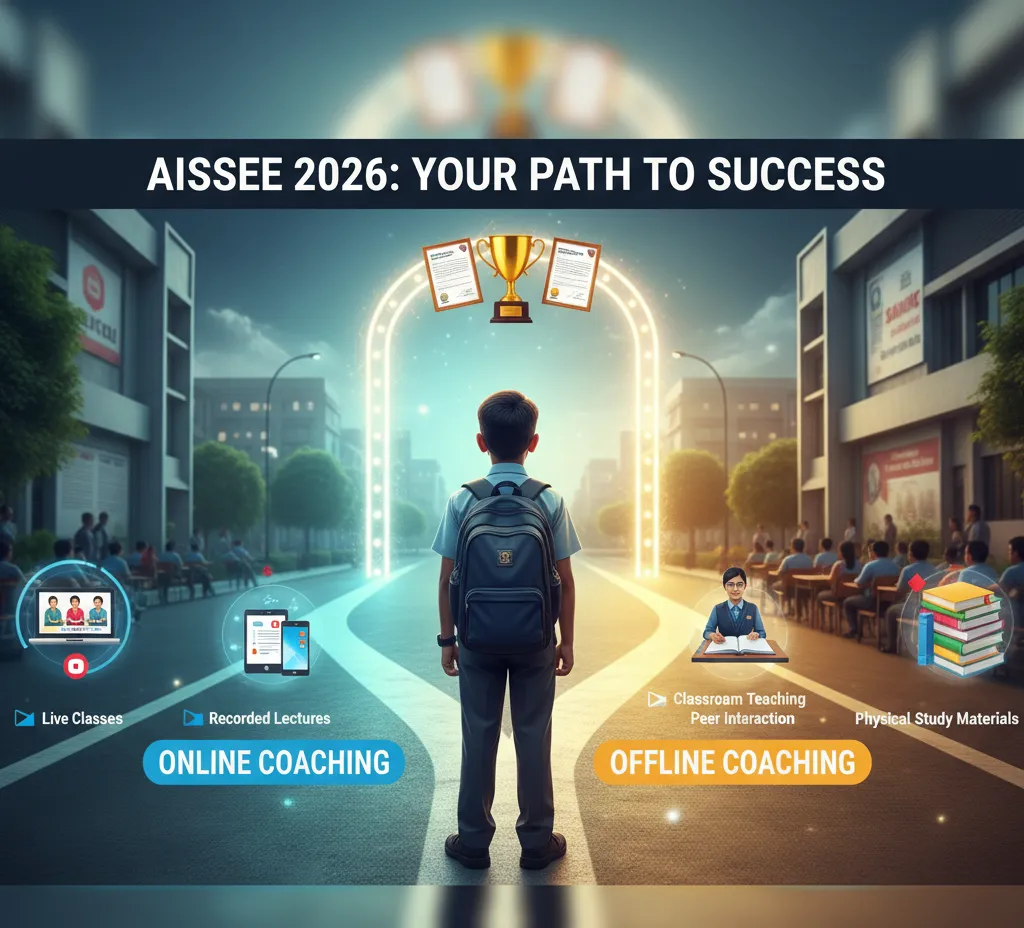
Cost Comparison:
Online Year 1: ₹44,000-78,000 Offline Year 1: ₹52,000-121,000
Online cheaper IF:
- Already have decent laptop/internet
- Device cost spreads over 2-3 years
Offline costlier if:
- Far commute (transport adds up)
- City with high transport costs
Real example: Vansh's parents thought offline ₹5,000/month = ₹60,000/year cheap. Actual cost: ₹60K coaching + ₹15K transport (long commute) + ₹5K snacks + ₹5K materials = ₹85,000/year
Switched to online: ₹12,000 coaching + ₹8,000 internet + ₹5,000 materials = ₹25,000/year (already had laptop)
Savings: ₹60,000/year. That's coaching for younger sibling too!
Cost Calculation For Your Family:
Online:
- Monthly coaching: ₹_____ × 12 = _____
- Device (if needed): ₹_____
- Internet upgrade: ₹_____ × 12 = _____
- Materials: ₹5,000
- TOTAL: ₹_____
Offline:
- Monthly coaching: ₹_____ × 12 = _____
- Daily transport: ₹_____ × 250 days = _____
- Materials: ₹5,000
- Snacks/food: ₹_____ (estimate)
- TOTAL: ₹_____
Difference: ₹_____
Factor 5: Parent Involvement Required
This is underestimated.
Online Coaching: Parent Supervision Needed
Parent responsibilities:
- Ensure child watches videos (not YouTube instead)
- Check if practice problems being done
- Monitor internet usage (not gaming while "studying")
- Track progress (coaching doesn't monitor as closely)
- Keep internet maintained, laptop charged
- Daily accountability
Time investment from parent: 10-15 min/day of checking
Parent supervision required: YES - Critical
If parent can't supervise: Online fails.
Offline Coaching: Less Parent Involvement
Parent responsibilities:
- Transport to coaching (or arrange)
- Ensure student attends (less temptation to skip)
- Collect feedback from coaching periodically
- Provide materials as needed
Time investment from parent: 20 min/day (just transport logistics)
Parent supervision required: LESS critical (coaching does some monitoring)
If parent busy: Offline still works (coaching provides structure).
Parent Availability Assessment:
Can you check child's progress daily (10 min)?
- YES → Online manageable
- NO → Offline better
Can you drive/arrange transport?
- YES → Either option possible
- NO → Online necessary (no transport needed)
Can you monitor to prevent gaming distraction?
- YES → Online viable
- NO → Offline has in-person monitoring
Factor 6: Child's Learning Style Preference
This is psychological, not logical.
Extrovert Child (Prefers interaction)
Characteristics:
- Likes asking questions verbally
- Learns better with classroom buzz
- Needs peer presence for motivation
- Bored in isolation
- Thrives on teacher attention
Online: Will feel lonely, might disengage Offline: Thrives (peer presence, instant interaction)
Verdict: Offline is RIGHT choice
Real example: Akshay is extrovert. Online coaching = Lonely. He stopped watching videos. Switched to offline. Thrives with friends in batch. Score improved 25 marks.
Introvert Child (Prefers independent learning)
Characteristics:
- Anxious in crowded classrooms
- Prefers working alone
- Doesn't like being called on
- Pressure from peer presence makes them freeze
- Comfortable learning independently
Online: Comfortable, focuses well Offline: Anxious, performs worse under pressure
Verdict: Online is RIGHT choice
Real example: Meera is introvert. Offline class = Anxiety. Afraid to ask doubts in front of 30 students. Online = Freedom to pause video, ask doubt anytime, no embarrassment.
Learning Style Assessment:
Do you prefer:
- Group discussion or independent work?
- Asking questions verbally or through chat?
- Peer motivation or solitude?
- Real-time teacher interaction or asynchronous learning?
Answers reveal: Extrovert (offline) vs Introvert (online)
The Real Decision Matrix (What Actually Matters)
Score each factor 1-10:
- Self-discipline: ___ (10 = very disciplined, 1 = needs external structure)
- Home environment: ___ (10 = perfect for study, 1 = chaotic)
- Time availability: ___ (10 = flexible, 1 = very busy)
- Budget: ___ (10 = cost not concern, 1 = every rupee matters)
- Parent supervision: ___ (10 = can supervise daily, 1 = can't supervise)
- Learning style: ___ (10 = introvert/independent, 1 = extrovert/needs interaction)
Scoring:
If score 40+: Online is GOOD choice If score 25-39: Could work either way If score <25: Offline is BETTER choice
Real Family Decisions (How Different Families Chose)
Family 1: Chose ONLINE
Profile:
- Child: Self-disciplined (9/10), introvert (8/10)
- Home: Quiet study room (9/10)
- Time: Flexible schedule (8/10)
- Budget: Limited (6/10) - ₹800/month affordable
- Parent: Works from home, can supervise (8/10)
Scores add: 9+9+8+6+8+8 = 48
Decision: ONLINE (perfect fit)
Result: Child scored 245. Saved ₹60,000/year vs offline.
Family 2: Chose OFFLINE
Profile:
- Child: Needs structure (4/10), extrovert (7/10)
- Home: Chaotic (3/10)
- Time: Tight schedule (4/10)
- Budget: Okay (7/10) - ₹6,000/month manageable
- Parent: Busy working (3/10) - can't supervise daily
- Learning style: Group-oriented (2/10 for online)
Scores add: 4+3+4+7+3+2 = 23
Decision: OFFLINE (necessary)
Result: Child scored 238. Offline structure was ESSENTIAL.
Family 3: Chose HYBRID
Profile:
- Child: Medium self-discipline (6/10), balanced (5/10)
- Home: Okay (5/10)
- Time: Moderate (5/10)
- Budget: Medium (5/10)
- Parent: Somewhat available (5/10)
- Learning: Balanced preference (5/10)
Scores add: 6+5+5+5+5+5 = 31
Decision: HYBRID (best of both)
Cost: ₹1,000/month online + 1 Saturday offline batch ₹1,500/month = ₹30,000/year
Result: Child scored 242. Got online flexibility + monthly offline personal interaction.
The Honest Truth About Each Option
Online Coaching (Real Talk)
Honest pros:
- Cost genuinely lower
- Time efficient (no commute)
- Can rewatch concepts
- Works IF child self-disciplined
Honest cons:
- Requires consistent self-study (hard)
- Easy to procrastinate (very easy)
- Home distractions constant
- Screen fatigue real (eyes hurt)
- Needs parental supervision
- Less personal connection
Best case: Disciplined introvert with quiet home = Success Worst case: Undisciplined child, busy parents = Complete failure
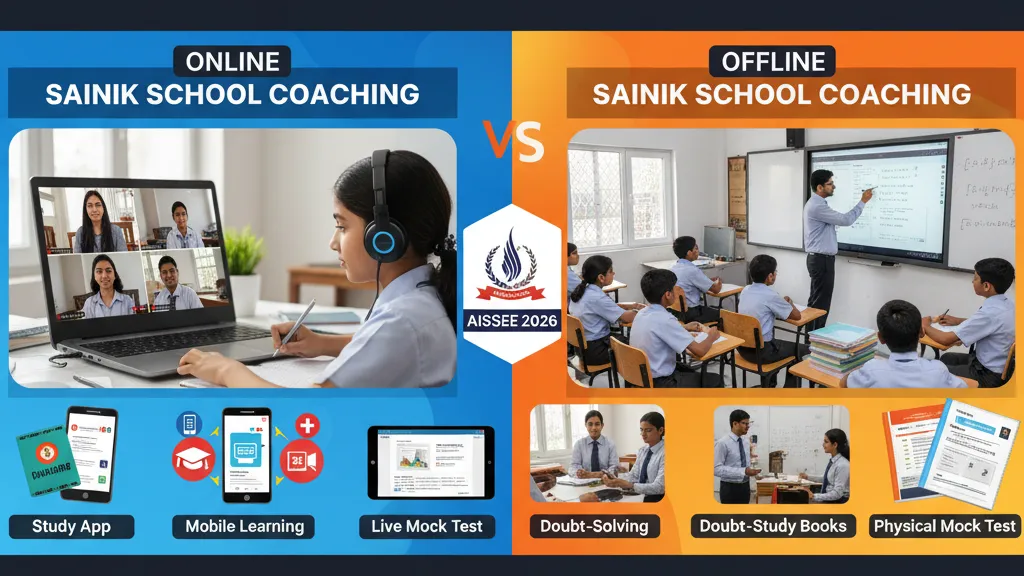
Offline Coaching (Real Talk)
Honest pros:
- External structure (shows up, studies)
- Teacher monitoring (notices struggles)
- Peer motivation real
- Best for undisciplined students
- Personal attention possible
Honest cons:
- Cost significantly higher
- Commute time lost (90-120 min daily sometimes)
- Fixed schedule inflexible
- One teacher only (can't switch if bad fit)
- Peer distraction possible
- Exhausting daily commute
Best case: Undisciplined extrovert with long home commute = Success Worst case: Introverted student, far commute, busy schedule = Regret
What Most Families Get Wrong
Wrong decision 1: Choosing based on friend's recommendation
"My neighbor's kid did online, got 250!"
Reality: Neighbor's kid might be highly disciplined. YOUR child might not be.
Right decision: Evaluate YOUR child's profile. Not neighbor's.
Wrong decision 2: Assuming cheaper = Good
"Online is ₹800, so let's do online!"
Reality: Online is cheap BUT useless if child won't study independently.
Right decision: Choose based on fit, not cost (though cost matters).
Wrong decision 3: Choosing without trying
"The coaching looks good on website, let's commit!"
Reality: Website looks great. Real experience might be different.
Right decision: Take free trial. Experience actual quality. Then decide.
Wrong decision 4: All-or-nothing thinking
"Must choose either online OR offline."
Reality: Hybrid exists. Combination works.
Right decision: Explore all 3 options.
The Decision-Making Process (What To Do NOW)
Step 1 (This week): Self-assess using factors above. Score your family.
Step 2 (Next week): Research 2-3 options (1 online, 1 offline, 1 hybrid).
Step 3 (Week 3): Take free trials (7-10 days each).
Step 4 (Week 4): Experience real learning. Note: How does child feel? Do they study? Is progress visible?
Step 5 (Week 5): Decide based on EXPERIENCE, not theory.
Step 6 (After decision): Commit for 2-3 months minimum (give adequate time to judge).
Timeline: 5 weeks to decide = Still have 7-8 months for AISSEE prep. Enough time.
Bottom Line - Online vs Offline Reality
There is NO objectively "better" choice. Only "better for YOUR family."
Decision depends on 6 factors:
- Child's self-discipline level (MOST important)
- Home environment quality
- Commute time available
- True total cost (not just fees)
- Parent supervision capacity
- Child's learning style
Decision matrix: Score each factor. 40+ → Online. 25-39 → Either. <25 → Offline.
Hidden truths:
- Online requires DISCIPLINE (child must study independently)
- Offline requires TIME (commute eats 3-4 hours daily)
- Hybrid requires MANAGEMENT (juggling both)
Real cost: Online ₹24,000-35,000/year Year 2+. Offline ₹52,000-121,000/year. NOT just coaching fees.
Parent role critical: Online needs daily supervision. Offline less supervision needed.
Commute calculation: 90 min daily commute = 375 hours/year = 15 days wasted on car instead of studying.
Wrong decisions common: Based on friend, cost alone, website appearance, inflexible thinking.
Right process: 5-week evaluation with trials, experience real learning, score-based decision, 2-3 month commitment to judge.
Real families: Family 1 (online perfect fit), Family 2 (offline necessary), Family 3 (hybrid best).
The truth: Disciplined introvert with quiet home → Online. Undisciplined extrovert with chaotic home → Offline. Balanced everything → Hybrid.
Your decision: Not about what's objectively better. About what fits YOUR child + YOUR home + YOUR schedule + YOUR budget + YOUR supervision capacity + YOUR child's personality.
Final wisdom: "I chose X coaching and it worked!" might not work for you. Choose based on your factors, not someone else's success.
Need help scoring your family profile and deciding? Contact us for personalized coaching selection guidance.
Want to read detailed experiences of families who chose each option? Read our blog for real story collection.