

Daily Schedule of a Sainik School Cadet: Hour by Hour

Sharma ji came to me in February. His daughter had been allotted Sainik School Kasturba and was joining in July.
"Sharma ji, I want to prepare her for the actual life before she goes. Not the school brochure version — the real version. What time does she wake up? What happens in the morning? When do they study? When do they eat? When is there free time? What does an actual day look like?"
Most families have a vague sense that Sainik School life is disciplined and structured. Almost nobody knows what the actual schedule looks like in practice.
Here's the complete, honest hour-by-hour breakdown of a typical Sainik School day.
A Note on Variation
The schedule varies slightly by school and slightly by season. The broad structure — early morning PT, academic classes, sports/activities, study hours, lights out — is consistent across all old Sainik Schools. Exact times may shift by 15-30 minutes depending on the specific school and its location (daylight hours differ significantly between Kerala and Haryana, for example).
This guide presents the typical structure for a mid-year day at most old Sainik Schools.
5:30 AM — Wake-Up Bugle
The day begins with the wake-up call — traditionally a bugle or PA system signal. Not optional. Not negotiable. 5:30 AM, every morning, 365 days of the year during term.
For new joiners in the first 2-4 weeks — this is the most shocking element. Children who were accustomed to waking at 7:30 AM or later find 5:30 AM genuinely disorienting.
By Month 2 — most students wake slightly before the bugle. The body clock adjusts.
5:30-5:50 AM — Morning Routine:
Wash face, brush teeth, use toilet. Change into PT kit. Make bed to specific standard — hospital corners, tight covers, pillow positioned correctly. Housemaster or senior cadets do random inspections. A poorly made bed means consequences.
This morning routine — compressed into 20 minutes — becomes one of the most efficient habits the student develops. By Year 2, the 20 minutes is completely automatic.
5:50 AM — Morning PT
All house members assemble on the PT ground. House-wise formation — students stand in their designated positions.
5:50-7:00 AM — Morning PT (70 minutes):
The PT programme varies by day:
Monday/Wednesday/Friday: Running. Typically 1.5-3 km depending on class. Warm-up stretches, run, cool-down exercises.
Tuesday/Thursday: Strength and exercises. Push-ups, pull-ups, sit-ups, burpees, rope climbing, parallel bars (at schools with equipment), circuit training.
Saturday: Sports day. Inter-house matches in cricket, football, basketball, volleyball, athletics depending on season.
The PT in Class 6 is calibrated for the age. It's demanding relative to what new students are used to — but not designed to injure or overwhelm. The standard increases progressively across years. A Class 10 student's PT is noticeably more demanding than a Class 6 student's.
Housemaster or PT master supervises. Senior cadets lead formations and exercises.
7:00 AM — PT Dispersal and Morning Hygiene
After PT: dispersal to dormitories.
7:00-7:30 AM:
Bath (cold water in many schools, or hot water on scheduled days). Change from PT kit to school uniform. Preparation for breakfast — shoes polished, uniform ironed (or uniforms pressed from previous evening).
The 30-minute window between PT and breakfast is tight. Students who are slow learn quickly to be efficient. Morning hygiene and uniform preparation at 7 AM are done faster by Month 3 than they seemed possible in Week 1.
7:30 AM — Breakfast
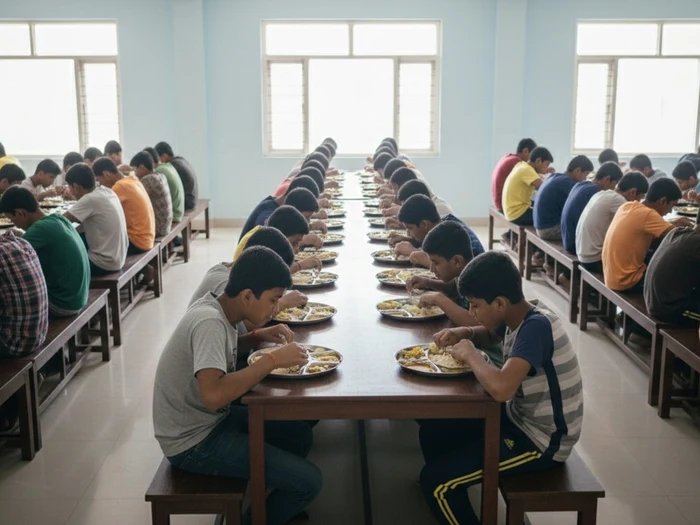
Mess hall. All students from the house eat together.
7:30-8:00 AM — Breakfast (30 minutes):
Typical breakfast menu varies by school and day. Usually includes: bread and butter/jam, milk, boiled eggs (some schools), paratha (some days), some fruit. Schools with South Indian demographics sometimes serve idli or dosa.
Breakfast is sit-down, at assigned tables, in uniform. Eating is not leisurely — 30 minutes covers the meal and any mess duties assigned to the house.
House officers (usually senior cadets in rotating duty)manage the mess during meals.
8:00-8:30 AM — Morning Assembly and House Inspection
8:00-8:15 AM: House assembly. Students fall into formation for morning prayer, national anthem, any announcements from Housemaster or senior cadet. This is when the day's schedule variations (if any) are communicated.
8:15-8:30 AM: Walk to school block. Sainik Schools have separate residential/house area and academic block. The walk between them marks the transition from house life to academic day.
8:30 AM to 1:00 PM — Academic Classes (Morning Session)
8:30 AM to 1:00 PM — Five periods (approximately 45-50 minutes each with short breaks):
Class structure follows CBSE curriculum. Subjects rotate through the week. For Class 6: Maths, Science, Social Studies, English, Hindi (or second language), Computer/General Studies, occasionally.
Academic environment: competitive. Teachers are generally qualified and experienced. Class sizes (25-35 students typically) allow more individual attention than many regular schools.
Teaching standard varies by school and subject — some Sainik Schools have genuinely excellent faculty in certain subjects; others have more variable quality. The competitive peer environment often compensates — students push each other.
Mid-morning break: 15 minutes, typically around 10:30-11:00 AM. Students return to house for a snack (biscuits, fruit, or milk depending on school) before returning to class.
1:00-1:45 PM — Lunch
1:00-1:45 PM — Lunch in mess hall:
Lunch is the main meal of the day. Dal, rice, chapati, vegetable dish, occasionally non-vegetarian on designated days (most schools have a mixed menu). Curd or pickle alongside.
Mess food quality varies significantly by school and by cook rotation. At its best — adequate and nutritious. At its less-good — repetitive and bland. Most students develop a nuanced relationship with mess food over their years: preferences, best days, which items to avoid.
Lunch includes a brief rest period — some schools have a formal rest period after lunch.
1:45-3:30 PM — Self Study / Optional Classes
1:45-3:30 PM — Structured afternoon period:
This period varies more than any other part of the schedule by school. Typical configurations:
Self-study period: students in their dormitory or study room for personal academic work. No formal class instruction — homework completion, textbook reading, personal revision.
Some schools use this period for remedial classes — students who need additional support in specific subjects get teacher attention in smaller groups.
Senior class students (Class 9-12) sometimes have additional classes scheduled in this period.
3:30-5:30 PM — Sports and Co-Curricular Activities
3:30-5:30 PM — Organised sports and activities:
This is one of the most important periods for the holistic development Sainik Schools are known for.
Sports rotation by season: cricket in winter, football in monsoon, athletics in summer (seasons aligned to regional climate at each school). Every student participates in the sport of the season. Inter-house competitions happen on Saturdays.
Co-curricular activities depending on school: NCC (National Cadet Corps), music, band practice, debate preparation, arts and crafts, gardening, school magazine editorial.
Swimming (at schools with pools): typically 1-2 sessions per week for allocated students.
The sports and activity period is where many students discover capabilities they didn't know they had. The Class 6 student who never ran a race becomes a decent distance runner by Class 8 through daily PT and sports engagement.
5:30-6:00 PM — Evening Snack and Free Time
5:30-6:00 PM:
Evening snack in mess (tea and something to eat — biscuits, bread, upma, or similar). Brief genuine free time — the only unstructured 30 minutes of the day for most students. Some use it for personal activities, informal socialising, or resting.
6:00-8:00 PM — Study Hours
6:00-8:00 PM — Mandatory study hours:
This is perhaps the most structurally important element of the Sainik School day from an academic outcomes perspective.
Two uninterrupted hours, every evening, for academic study. No phone. No television. No social media. Just study.
Study hours are supervised — Housemaster or designated duty teacher circulates. Serious violations of study hour norms (sleeping, not studying) are addressed.
For Class 9-12 students: study hours often extend to 9 or 9:30 PM.
The cumulative effect of 2+ hours of daily structured study across a school year is significant. Sainik School students complete more focused study time annually than most regular school students precisely because this period is non-negotiable.
8:00 PM — Dinner
8:00-8:30 PM — Dinner:
Lighter than lunch. Chapati or rice, dal or vegetable, accompaniment. Often includes milk.
Post-dinner: brief free time, dormitory return, preparation for the next day (uniform preparation, bag packing, any last items before sleep).
9:00-9:30 PM — Lights Out
9:00-9:30 PM — Dormitory lights out:
Lights off. Official sleep time. Housemaster or duty staff does dormitory rounds to ensure lights are out and students are in their beds.
In practice: dormitory conversations continue in whispers for 15-30 minutes after lights out, especially in lower classes. This is the unofficial social time of the day — quieter, more personal conversations happen between students after lights out. Many genuine friendships deepen in these post-lights-out 20-minute conversations in the dark.
By 10 PM — most students are genuinely asleep. The 5:30 AM wake-up creates real fatigue by evening.
Sunday Schedule — The Different Day
Sundays have a modified schedule:
Later wake-up: 6:00-6:30 AM (some schools).
Morning PT: shorter or lighter than weekday schedule.
Morning: Dormitory and personal area cleaning. Uniform and clothing maintenance — ironing, repairs.
Mid-morning: Church/temple/mosque attendance (students of respective faiths attend services at school facilities).
Sunday phone call period: The designated time when students can call parents. Typically 10 AM-12 PM or similar window. Call duration: 10-20 minutes depending on school.
Afternoon: Relatively free — personal activities, games, letter writing, personal study if desired.
Evening: Normal mess dinner. Normal lights out.
Sunday is the day parents receive their weekly update on how their child is doing.
What This Schedule Actually Does to a Child Over 7 Years
Understanding the schedule helps parents understand the transformation.
5:30 AM wake-up daily builds: the internal clock that makes Rao ji's son wake at 5:45 AM during vacation without an alarm.
Daily PT builds: physical fitness as default state, not as occasional effort.
2-hour mandatory study hours build: the ability to sustain focused academic effort daily without negotiation or reminder.
Tight morning routine (wake to breakfast in 2 hours) builds: efficiency in personal management.
No phone, no television during term builds: the ability to engage with real peers and real activities rather than screen proxies.
The schedule is the curriculum that nobody lists on the school's website. It's what actually produces the different person that parents observe when their child comes home.
For Sainik School coaching and admission support — and for families wanting to understand what the 7 years after AISSEE actually looks like — we help families prepare for the full journey.
Daily Schedule Quick Reference
| Time | Activity |
|---|---|
| 5:30 AM | Wake-up bugle |
| 5:30-5:50 AM | Morning routine, bed-making |
| 5:50-7:00 AM | Morning PT |
| 7:00-7:30 AM | Bath, uniform preparation |
| 7:30-8:00 AM | Breakfast |
| 8:00-8:30 AM | Assembly, walk to academic block |
| 8:30 AM-1:00 PM | Five academic periods (with mid-morning snack break) |
| 1:00-1:45 PM | Lunch |
| 1:45-3:30 PM | Self-study or optional classes |
| 3:30-5:30 PM | Sports and co-curricular activities |
| 5:30-6:00 PM | Evening snack and free time |
| 6:00-8:00 PM | Mandatory study hours |
| 8:00-8:30 PM | Dinner |
| 9:00-9:30 PM | Lights out |

Bottom Line
Sainik School day: 5:30 AM wake-up through 9:30 PM lights out. Tightly structured with specific purpose for each block.
Key schedule elements: daily PT (5:50-7:00 AM), five academic periods (8:30 AM-1:00 PM), sports and activities (3:30-5:30 PM), mandatory study hours (6:00-8:00 PM).
Sunday: modified schedule, longer sleep, phone call period (typically 10 AM-12 PM), relatively free afternoon.
The schedule is the curriculum nobody lists. Over 7 years, it builds the early rising, physical fitness, academic discipline, and efficient self-management that makes Sainik School graduates recognisably different from their peers.
Understanding the schedule before joining helps children know what to expect — removing the shock of discovering it in Week 1 from a position of complete unfamiliarity.
Need guidance on preparing your child for Sainik School life and schedule before they join? Contact us for practical parent support throughout the journey.
Want more honest guides on Sainik School daily life, hostel experience, and what the school years actually involve? Read our blog for complete guides on every aspect of the Sainik School experience.